
How to develop a content strategy
A well-thought-out content strategy enables you to deliver high-quality content and create a positive content experience that boosts customer loyalty and conversions.
When planning a website structure, we place great importance on semantics while taking both SEO and UX aspects into account.

Information architecture refers to the organisation and structuring of information. It forms the foundation of a website and describes both its visible structure and the underlying logic that determines where and how content is created.
A website that is logically structured and clearly organized hierarchically helps users find their way around quickly. As a result, it has a direct impact on a satisfying customer journey through contextual user guidance and ultimately promotes a positive brand experience.
A well-thought-out information architecture also helps search engine algorithms better understand the content of a page and identify, recognize, and evaluate coherent thematic clusters.
That's why our SEO consultants (f/m/x) and our UX designers (f/m/x) work closely together when planning website structures and creating information architectures for our clients.
Information architecture is not necessarily the same as navigation. The two can overlap, but they do not have to be identical. While information architecture represents the structural framework of a website, navigation is responsible for making content accessible.
This means that navigation does not always have to follow the information hierarchy exactly. From a UX perspective, it can make sense to display content in navigation elements that are located lower in the hierarchy or on different levels of the information architecture.
Navigation includes not only the main menu, but also breadcrumbs, the home button, and meta or footer navigation, for example.
Semantics is, first and foremost, the study of meaning in linguistic signs – whether words, sentences, or entire texts. Semantics also plays a key role in search engine optimization. Since the introduction of Google’s Hummingbird algorithm in 2013, Google has focused on so-called semantic search. Instead of simply analyzing individual words (keywords), search engines now evaluate the contextual meaning of content in order to best match user search intent.
Google primarily recognizes semantic context through so-called entities. The term originates in philosophy, where it refers to an abstract or concrete subject or object within ontology (the theory of being) that exists independently.
The concept was later adopted in computer science, where an entity describes an object that can be clearly defined. Google uses entities to identify and evaluate semantic relationships. Content about the entity 'Berlin,' for example, should include semantically relevant terms such as 'capital,' 'Germany,' 'Brandenburg Gate,' or 'Bundestag' to clearly describe the entity.
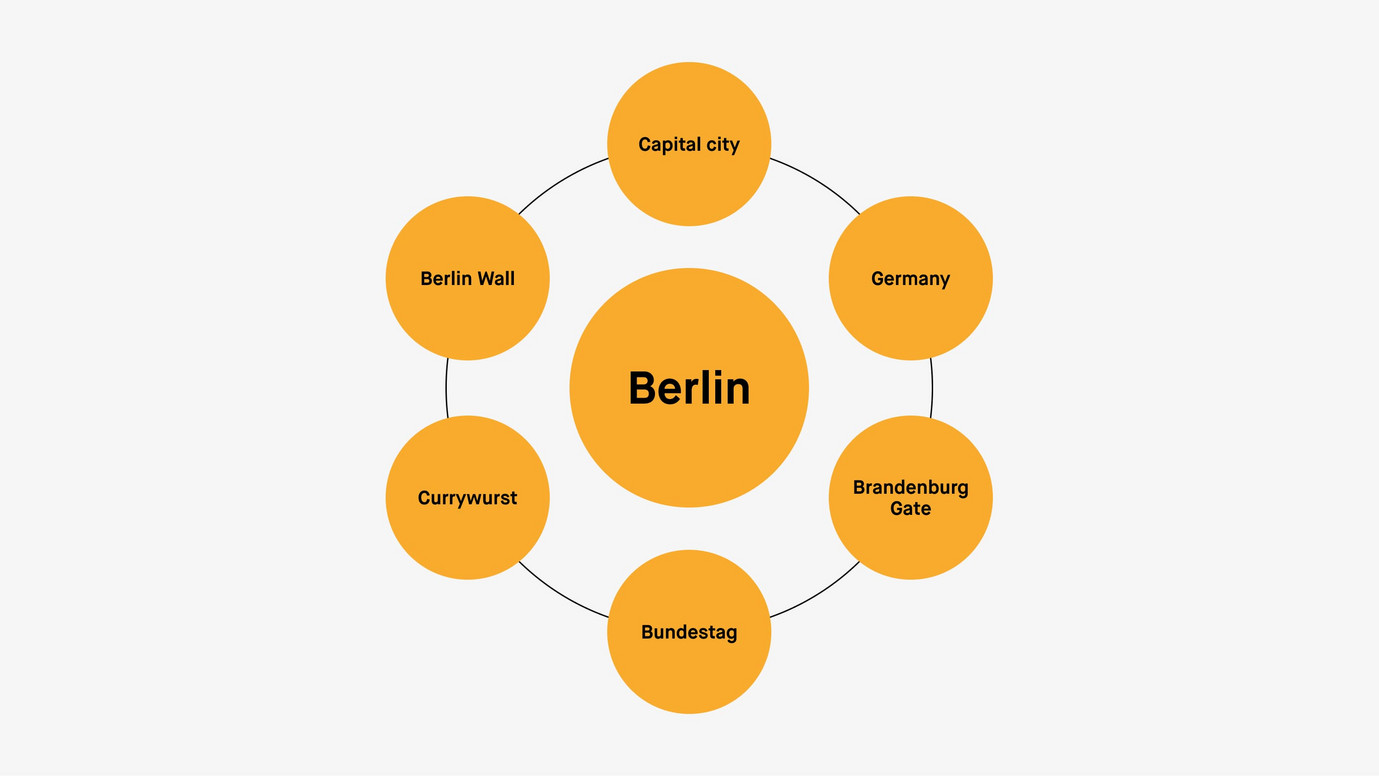
Although there are tools that attempt to identify relationships between entities, they should not be relied on blindly. It is far more important for SEO consultants to conduct manual research when creating SEO content briefing and to closely analyze search results. Our content writers are trained to recognize and work within this semantic context as well. When we create content on the topic of 'pizza,' for example, it is only natural to include semantically related terms such as 'Naples' or 'cheese.' A thoughtful and experienced content team can often achieve better results than automated tools alone.
These contexts of meaning are also essential for website structure, which is why we at Moccu speak of a semantic information architecture. We assign all content to meaningful subject areas (labeling) and give them unique, search engine-optimized names (classification).
Google recognizes entities and uses them to evaluate entire websites. Semantic clusters are formed within the information architecture, with the goal of covering a topic as comprehensively as possible through related content. As a result, topical authority is rated higher, and all content within the cluster benefits from improved rankings.
There are various ways to structure a website. A semantic information architecture differs significantly from a classic blog structure without a clear hierarchy. This distinction is often described as a tree structure versus a blog or network structure.
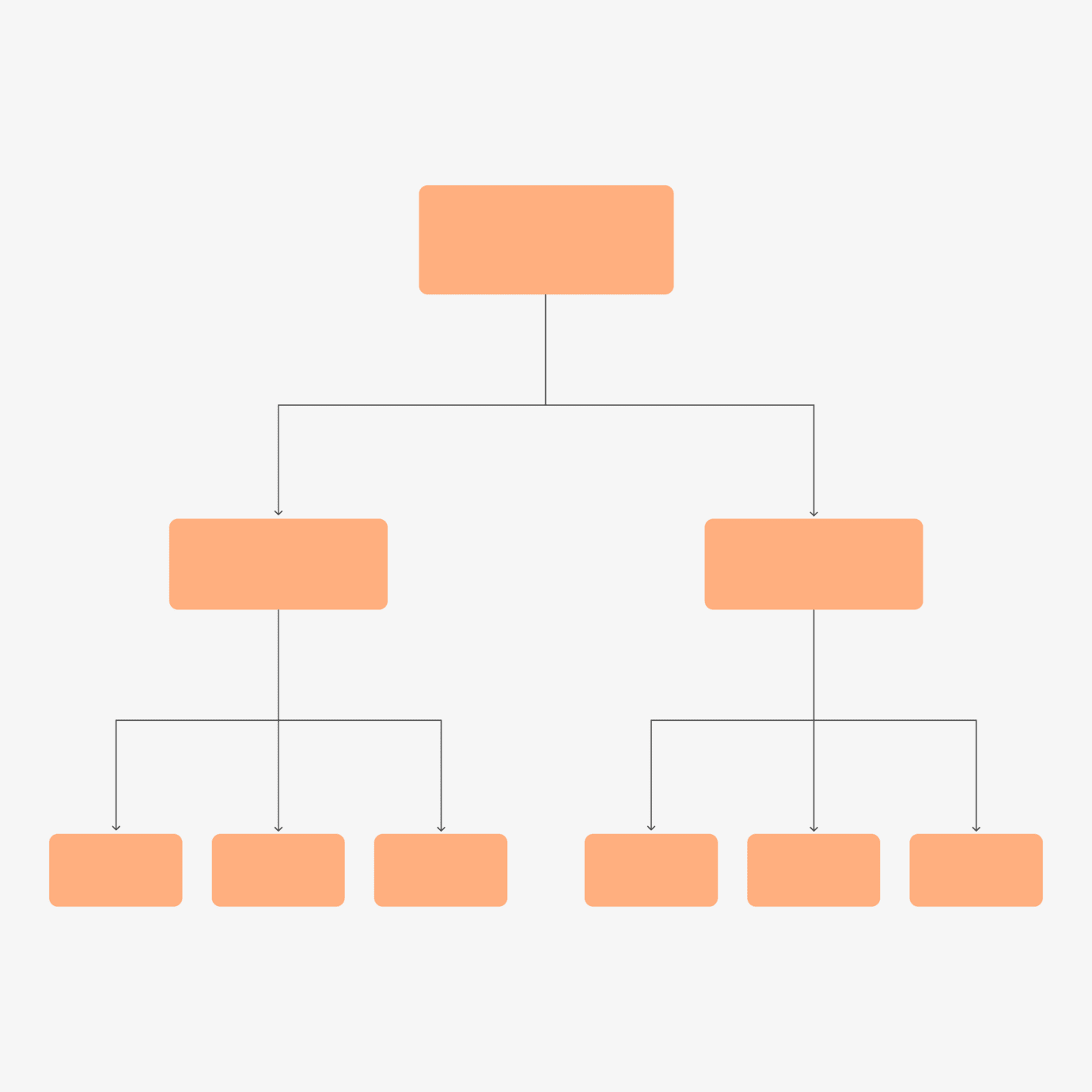
As the name suggests, a tree structure branches out like a tree. Relevant subtopics are grouped under a main category, from which suitable content branches off.
As users move deeper into the structure, the information becomes increasingly specific, while contextual relationships remain clear for both users and search engines.
Example: https://www.ihremarke.de/kategorie/thema/contentartikel/
But be careful: Aim for a hierarchy that is as flat as possible to prevent users from getting lost in the information architecture and to ensure that Google crawlers can index pages efficiently.
At the same time, do not force all content into an artificially flat hierarchy if additional levels are logically meaningful and necessary. Ultimately, the key is a well-planned hierarchy that makes all content easy to access.
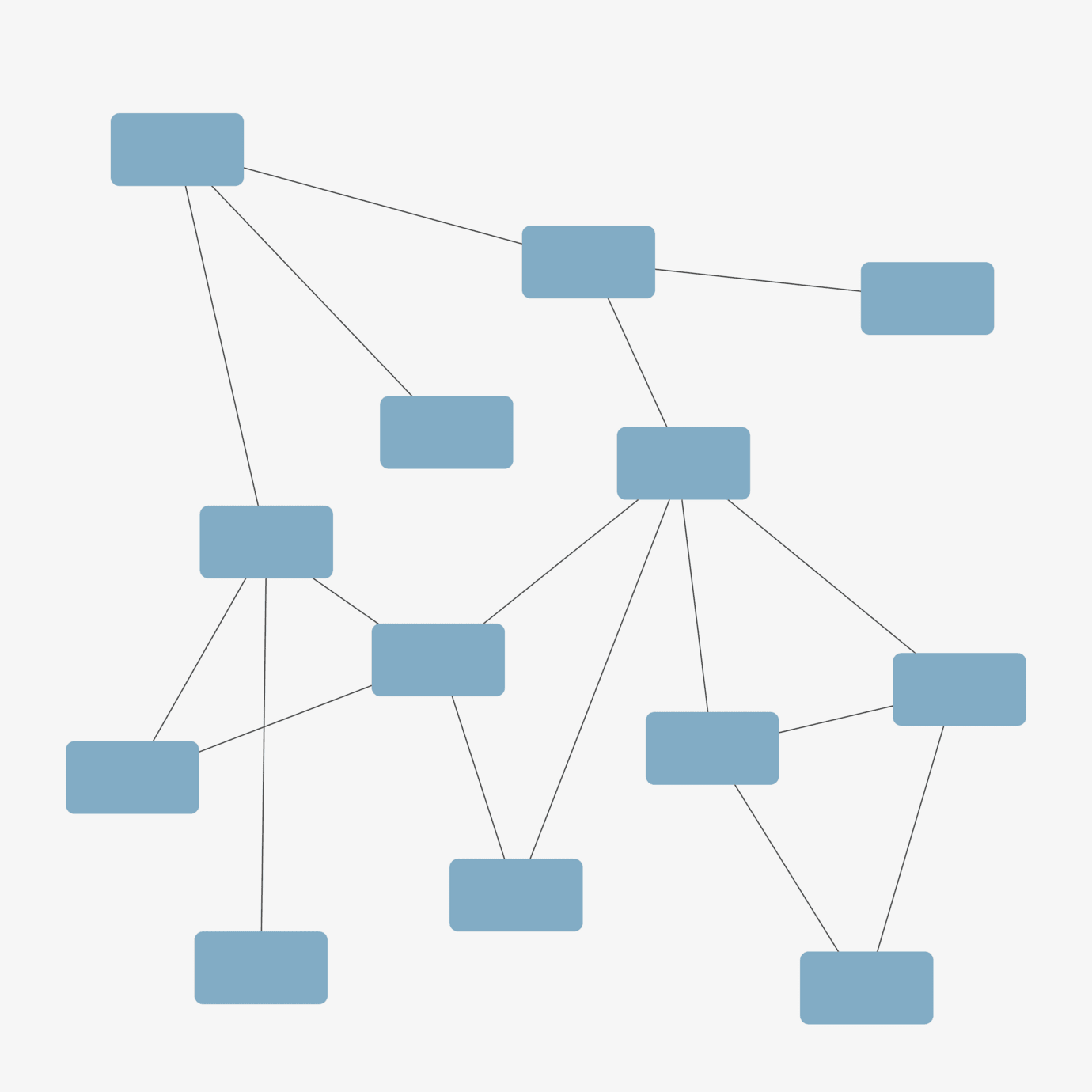
A blog-style structure does not have a clearly defined information hierarchy. Instead, the website resembles a spider’s web, with content distributed from the homepage and interlinked throughout. This is also known as a network structure.
Any hierarchy that does exist is usually based on publication date, with the most recent content displayed first.
Example: https://www.ihrblog.de/blogpost/ or https://www.ihrblog.de/jahreszahl/blogpost/
The network structure can be an advantage on certain websites if it is not necessary to depict thematic clusters. However, it harbours the risk of becoming confusing and overwhelming users.
In certain cases, a network structure can be beneficial, especially when thematic clustering is not required. However, it also carries the risk of becoming confusing and overwhelming for users.
Are you planning a comprehensive SEO-driven content production with a corresponding strategic focus? Then you should do without a network structure. When we develop a content strategy for our clients, we always create a semantic information architecture based on the advantages mentioned above.
Want to maximize your content marketing ROI? Boost your visibility, attract qualified traffic, and increase your conversion rate with a content strategy built on precise, data-backed insights.
Taxonomy refers to the categorization of objects according to defined criteria, in other words, classification. The term is best known from the natural sciences, particularly zoology, where animals are classified into genera and subgenera. This already shows that taxonomy is often, though not always, hierarchical.
When website content is categorized within a taxonomic hierarchy and divided into logical categories, a user- and search engine-friendly tree structure is created.
So-called tags, or keywords, can also form taxonomies that group content across categories. However, caution is advised. While tags are common in blog structures, they typically do not follow a clear hierarchical logic.
When planning your website structure, you should take care to avoid so-called silos during implementation. Siloing refers to the strict separation of thematic clusters on a website.
Many SEO agencies still recommend avoiding cross-links between topic areas and instead creating isolated silos in which only related content links to one another. We strongly advise against this approach.
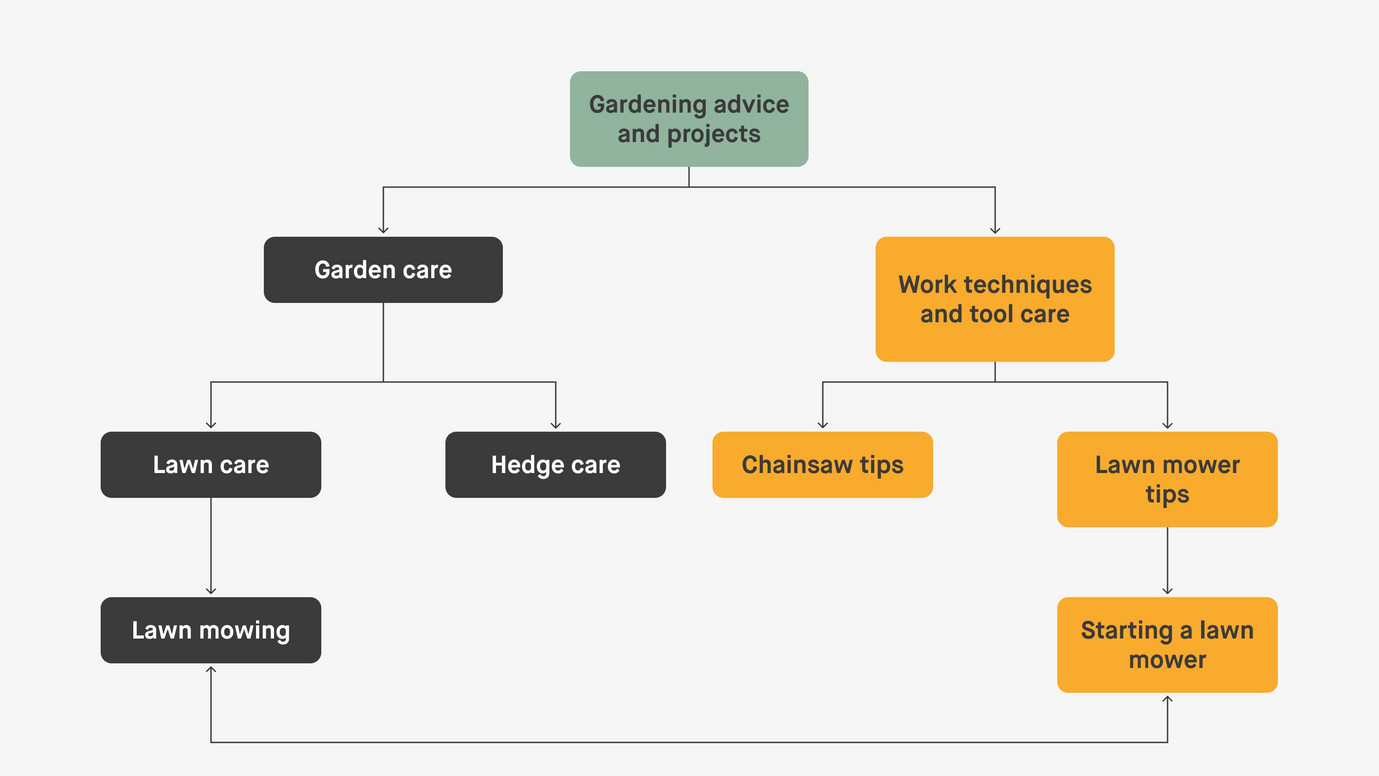
From both an SEO and UX perspective, silos do not make sense - On the contrary, we recommend always including links between individual topic clusters when they provide added value for the user at that point. Consider this example: A user is reading the article 'Mowing the lawn' within the topic cluster 'Lawn care.' Why should you avoid linking to the related cluster 'Lawn mowing tips'?
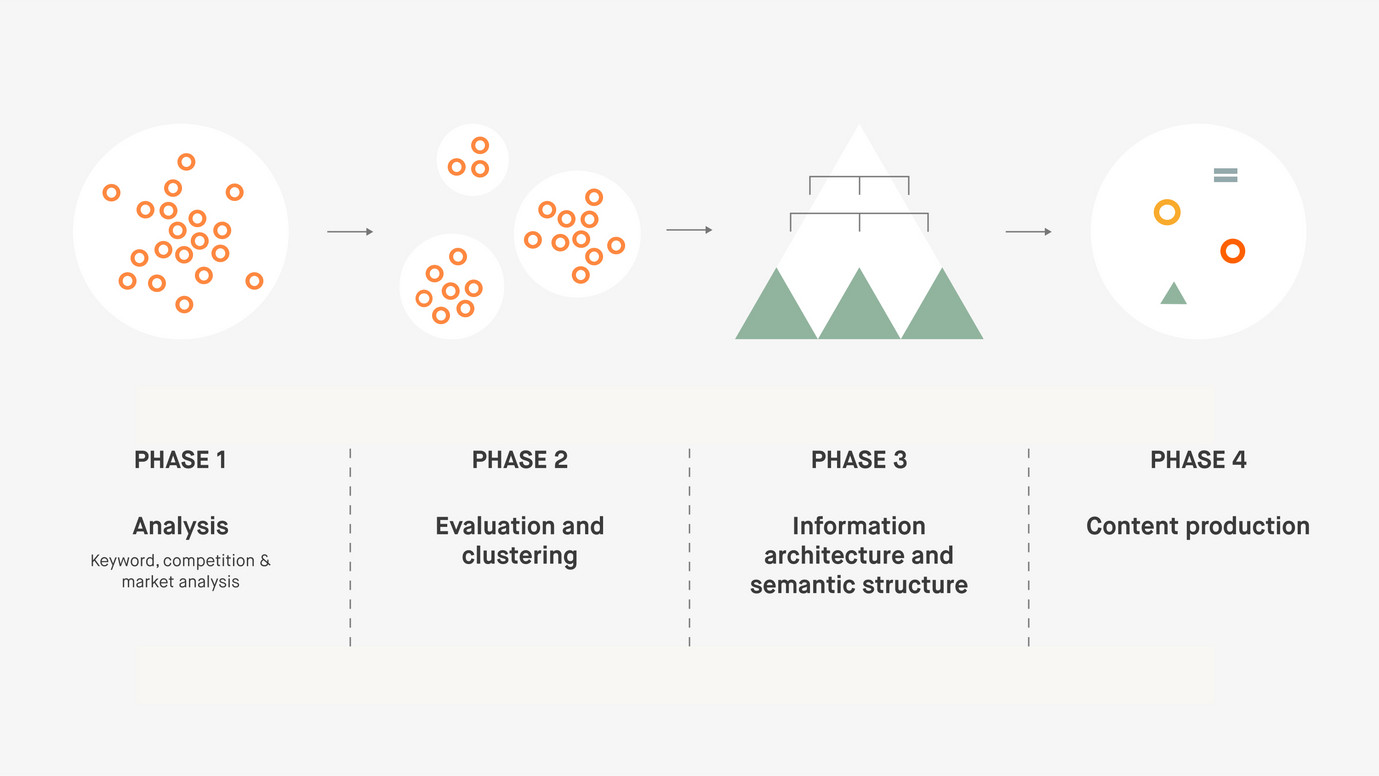
We always begin with a content audit, a complete inventory of all existing content on a website. During qualitative evaluation, we decide which content should be retained, revised, or removed. This process often reveals important thematic gaps that can be addressed strategically.
Next, we conduct a comprehensive keyword, competition, and market analysis to identify topics and keywords that are relevant to our clients’ target audiences.
We then evaluate and cluster the results. Based on this, we create a semantic content pyramid that serves as the blueprint for the website’s information hierarchy.
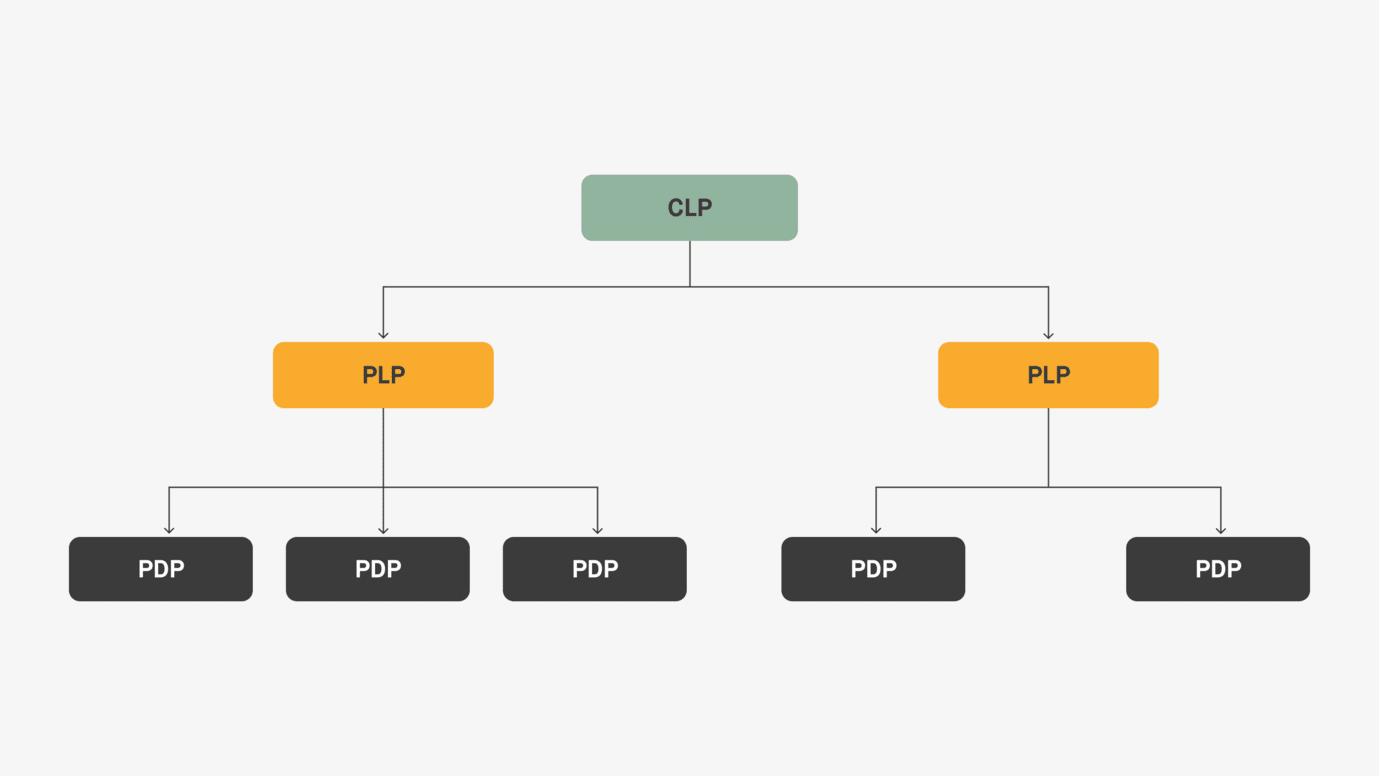
For product pages, we differentiate between category listing pages, also known as meta categories (CLP), product listing or category pages (PLP), and product detail pages (PDP). For guide articles, we differentiate between hub pages, content articles, and so-called frame articles.
A CLP (Category Listing Page) is a page in an online shop that lists the various categories within a product group. It therefore represents a top-level category within the product range, which is why we also refer to this type of page as a meta category. Products such as highlighted items or bestsellers can be featured on a CLP – but this is not required.
A PLP (Product Listing Page) represents the next level within an online shop. It is sometimes also referred to as a POP (Product Overview Page) or simply a category page. This page can be compared to a well-stocked shelf in a specialty store, as it lists all products within a given category. Products should be filterable based on meaningful criteria.
For categories with a high need for guidance, it is advisable to include suitable advisory content on the page. However, this should go beyond the classic SEO texts that many online shops still place below product lists solely to include keywords and improve Google rankings.
Instead, the content should genuinely provide advisory value, and be designed to be usable and easily discoverable. At Moccu, SEO, UX, and UI once again work closely together when designing PLPs.
In an online shop, a PDP displays a specific product. To continue the specialty store analogy: The PDP is essentially the online equivalent of a product’s packaging, which you take off the shelf to read detailed information on the back.
In a simplified customer journey, a user reaches a meta category (CLP) via the homepage of an e-commerce website, navigates to the desired category page (PLP), selects a product (PDP) – possibly after consulting helpful content – and ideally adds it to their shopping cart.
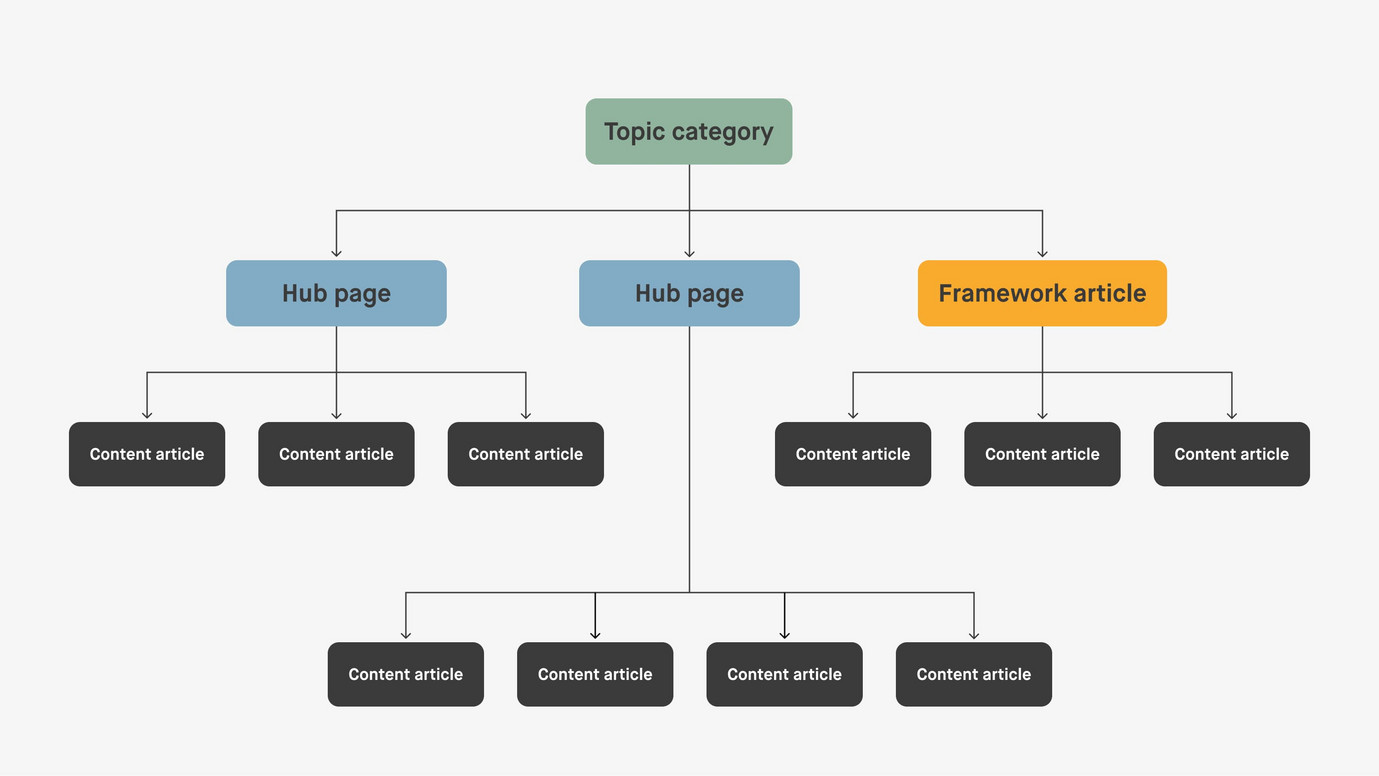
This hierarchical structure applies not only to product areas but also to guide content. Here, too, we follow a structure that moves from broad to specific. Semantically relevant topic areas (hub pages) are first grouped under a higher-level category, with corresponding content articles assigned beneath them.
Example: The mobile phone tips category category includes hub pages such as 'Mobile phone battery: tips,' 'Protect display,' and 'Connect mobile phone.' These hub pages, in turn, feature teasers linking to guide articles such as 'Charging your mobile phone correctly', 'Bulletproof glass or film?' or 'Connecting your mobile phone to the TV'.
This approach creates comprehensive category clusters, which also have a positive impact on Google’s E-A-T concept. Google uses this framework to evaluate content relevance based on expertise, authority, and trustworthiness.
Hub pages, which we at Moccu refer to as frame articles, represent a special case. A hub page typically serves primarily as an entry point to the content categorized beneath it. Teasers provide users with a quick overview and allow them to navigate further from there.
In some cases, however, for example when the primary keyword of a planned hub page predominantly ranks for advisory articles, a different approach may be required.
In these situations, we create a hybrid of a hub page and a content article. The page is structured like an article and provides users with in-depth information on the topic. At the same time, strategically placed links guide users to more specific subtopics that are directly related to the hub.
Example: The article Trimming hedges covers the main topic in detail, while more specific content such as Pruning cypress trees is positioned as subordinate.
We also distinguish between content articles and marketing pages, such as campaign pages. Regardless of whether a campaign is one-time or recurring, campaign pages should not be forced into the semantic information architecture. Instead, they are categorized separately within the website structure, usually with a concise URL directly below the homepage.
Example: A campaign for the market launch of a new STIHL chainsaw should not be placed under the hub page 'Chainsaw tips,' but should instead be accessible via https://www.stihl.de/beispielkampagne.
When planning a website structure, you should ensure that it is scalable, meaning it can be expanded at a later stage. This helps prevent categories from becoming catch-all containers for topics that only loosely belong together.
If you create additional content as part of your content strategy, you should take SEO relevance, target audience fit, and potential product placement into account, as well as whether the topic can be meaningfully integrated into the semantic information architecture.
Companies that operate in international markets and plan to roll out their website in additional countries should also ensure that scalability is not limited to a single site. The website structure should be scalable at an international level as well.
We help international brands grow global traffic and increase conversions. Our clients benefit from a network of local SEO experts who understand their markets inside and out.
This does not mean that your information architecture should be a rigid framework. On the contrary, it must allow for adjustments when necessary and make it possible to reorganize and move content as needed.
It is important, however, that such changes are based on sound data analysis and primarily focus on topics that are relevant to your brand.
We set up comprehensive performance tracking for our clients, enabling us to monitor SEO performance and make UX measurable. As part of SEO analyses, user testing, and user surveys, it may become clear that the information architecture needs to be revised. This is particularly true for continuously growing websites that eventually outgrow their originally planned tree structure.

We’ll get back to you as soon as possible.