The impact of loading time and UX on conversion
Mobile conversion and website speed


In many client meetings, people talk about media budgets, conversion, user experience (UX), and content – but rarely about website speed, progressive web apps (PWA), or mobile conversion rates. Yet site speed is now one of the most powerful levers for increasing conversion and overall success, whether or not a site is transactional. Even when purchases aren’t made online, 62 per cent of Germans often carry out mobile research before buying in-store to get inspiration, compare prices, or look up product details.
Before we think about what future SEO content we can write (i.e. long before we create the first SEO content briefing), we need to analyze the current content in detail.

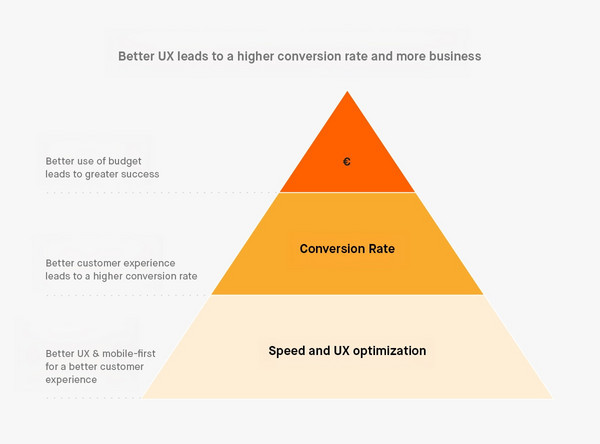
Recent studies show that mobile use now far exceeds desktop and continues to grow, a trend confirmed by many of our clients. Yet the average mobile conversion rate remains only about half that of desktop. This means there’s a large, growing segment full of untapped potential – with high opportunity costs but even greater rewards.
Still, few companies have recognized that the mobile conversion rate is a key sales driver or realized that it is a critical factor in digital transformation.
Website speed is a customer's first impression
The loading speed is the very first impression a consumer gets of a company, and often remains the only one.
It’s simple: fast websites are automatically perceived as more professional and trustworthy. People instinctively associate speed with reliability and efficiency.

Reduce bounce rate and CPA Reduce load times on landing pages and websites to improve Google rankings
The direct correlation between website speed, bounce rate and conversion has been proven by Akamai and Google. Based on a one-second load time, Google found the following results:
- Bounce rate increases by 32% at three seconds
- 90% higher at five seconds
- 106% higher at six seconds
- 123% higher at ten seconds
Amazon famously stated that every additional second of load time costs a company 1.6 billion US dollars in sales per year.
Zalando confirmed a similar finding in 2018: for every 100 milliseconds faster loading time, the company gained 0.7% more profit per visit.
And OTTO's manager Olaf Schlüter stated with regard to the improved load times across the Group in 2018: "When it comes to customer focus, fast websites are a must."
Google integrated website speed as a ranking factor in its search algorithm back in 2010. Since July 2019, the mobile index has also become standard for new websites. This means that new sites are evaluated primarily based on their performance on mobile devices. Google has also stated that websites loading too slowly on mobile will be penalized in search rankings.
"The optimum loading times for the lowest bounce rate are between 700 milliseconds and 1.2 seconds across all devices."
– Akamai „State of Online Retail Performance“, 2017
Sounds exciting?
UX for business UX drives real business results
When leaders at non-digital companies, or even large corporations, hear the term user experience (UX), they often don’t know what to make of it. Some roll their eyes or joke, “UX… sounds like Scotty in the engine room,” or “Yes, we’ve already done all that.”
It can sometimes feel as though the more people use the term, the less they truly understand it. User experience and customer centricity are everywhere in corporate language, yet the potential that comes from consistently optimizing UX across all digital and non-digital touchpoints often goes untapped.


At its core, UX is about creating simple, intuitive, and enjoyable experiences for users. In essence, there are two basic principles:
- Give users what they need.
- Give it to them as quickly as possible.
A strong UX and a relevant offering create satisfied customers, define the brand experience, and drive recommendations. For most established companies, this is now the most effective way to build sustainable competitive advantages.
In a digital, highly connected world, every product contributes to the customer’s overall brand experience. A consistently positive user experience is therefore the foundation of a successful customer relationship.
This becomes even more important as online advertising costs continue to rise. Once the cost of acquiring new customers exceeds their lifetime value (CLV), growth becomes unsustainable. The solution is a compelling digital offering built on a conversion-optimized UX.
UX doesn’t belong in the engine room – it belongs on the bridge. Spotify’s CFO, Barry McCarthy, captured this perfectly in Mary Meeker’s Internet Trends Report 2019:
“Effective and efficient marketing = your own product + happy customers + recommendations.”
„Developing a better user experience produces by far the most impact for growth.“
– Barry McCarthy, CFO Spotify, 2018
Success is predictable Consider scenarios and marginal costs
We don’t rely on assumptions. Instead, we calculate specific scenarios to optimize a website’s conversion performance. This approach allows us to compare the projected investment directly with the potential gains and economic ROI.
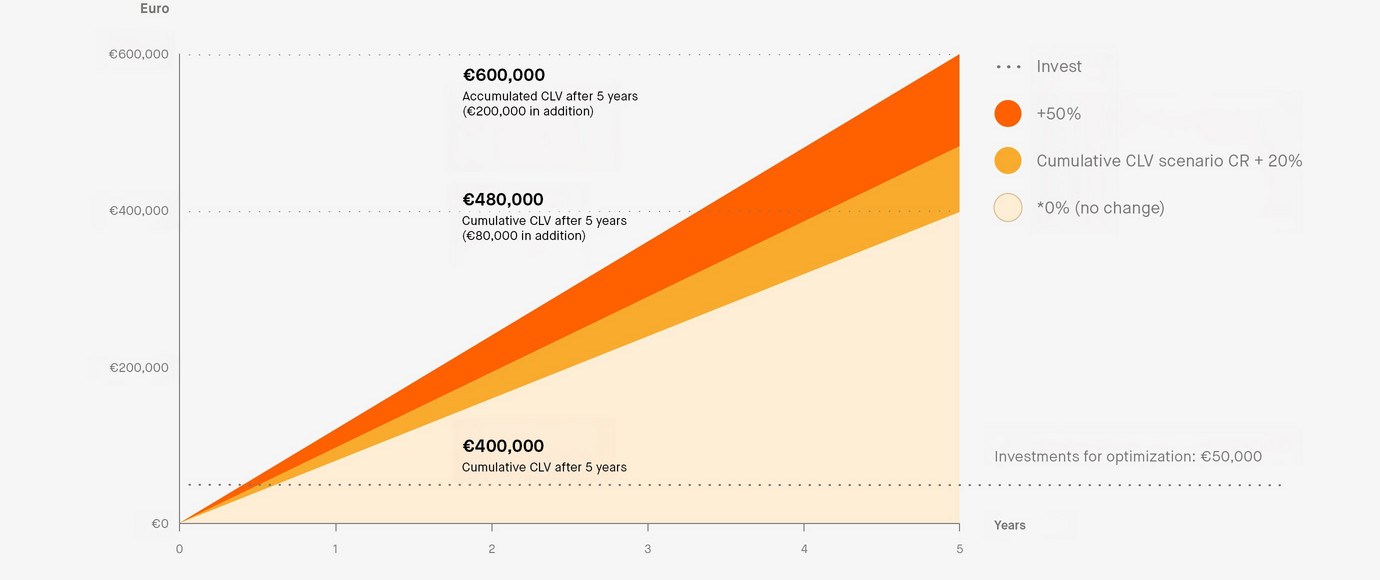
When we’re confident that measurable optimization is achievable, and that’s often the case, we offer clients a performance-based fee model. The chart below shows an example income statement illustrating different conversion rate scenarios.
Example calculation of the cumulative customer lifetime value (CLV) after optimisation
Assumptions: Conversion rate 2 %, CLV 20 Euro

How we improve site performance with AMP and PWA:
-
1. Status Quo:
As a Google partner for mobile conversion and site speed, we begin with a detailed audit to assess the current situation.
-
2. Strategy:
We define clear goals, map the user journey, and develop a mobile-first asset strategy.
-
3. Implementation:
We deploy the mobile site using AMP and PWA technologies and set up dashboards to measure how website speed impacts advertising budget efficiency.
-
4. Growth:
Long-term success depends on consistency. Many brands lose momentum after the initial push, so we plan quarterly reports and create ongoing content to sustain performance and growth.
External links Resources on conversion rates, AMP, PWA, and site speed:
- Internet Report 2019, Mary Meeker
- Think with Google: Find out how you stack up to new industry benchmarks for mobile page speed
- Think with Google über In-store-Suche: das Smartphone als Einkaufssupport
- Think with Google: Verpasste Chancen: Nur 5 % der deutschen mobilen Websites laden innerhalb einer Sekunde
- Zalando: Loading Time Matters
- Infographic: The Interesting Effect of Speed on Conversion Rates
- Medium-Artikel: Impact of slow page load time on website performance
- Fast Company: How One Second could cost Amazaon $ 1.6 Billion in Sales
Sounds interesting? Arrange an initial consultation.

Thank you!
We’ll get back to you as soon as possible.

